Is Tree Removal Necessary? How Cobra Cabling Helps Preserve At-Risk Trees
December 2, 2025
Learn how Cobra cabling supports weak or splitting trees, when it’s the right alternative to removal, and how arborists decide if your tree is a good candidate.
Have you ever walked outside after a storm and noticed a major limb split, a trunk starting to crack, or a tree that suddenly looks… off? That moment of “Is this dangerous?” hits fast – and the uncertainty that follows is often worse than the problem itself. Should you call someone right away? Wait and see? Cut it down before it falls?
Concerns like these are valid. Structural issues in a tree can escalate quickly, and ignoring them can put people, homes, and historic properties at risk. Here in Winston-Salem’s established neighborhoods, mature oaks and maples are part of the charm, but they can also develop weaknesses that need expert attention.
Key Takeaways
- Tree cabling, especially modern non-invasive systems like Cobra, can preserve mature trees with structural weaknesses for 10-15+ years at a fraction of removal cost.
- Co-dominant stems (the V-shaped split where two trunks meet) are the most common structural defect in Winston-Salem’s landscape trees, particularly in oaks and maples.
- Not every weak tree can be saved; trees with significant decay, disease, or cracks in the union typically need removal rather than cabling.
- A single mature tree can add thousands of dollars to your property value, making preservation worth serious consideration when it’s a viable option.
- Only an ISA Certified Arborist can properly assess whether your tree is a candidate for cabling or if removal is the safer choice.
Why Do Some Trees Need Structural Support?
Some trees develop structural defects that create weak points prone to failure during storms. Here’s what causes these problems and how to spot them.
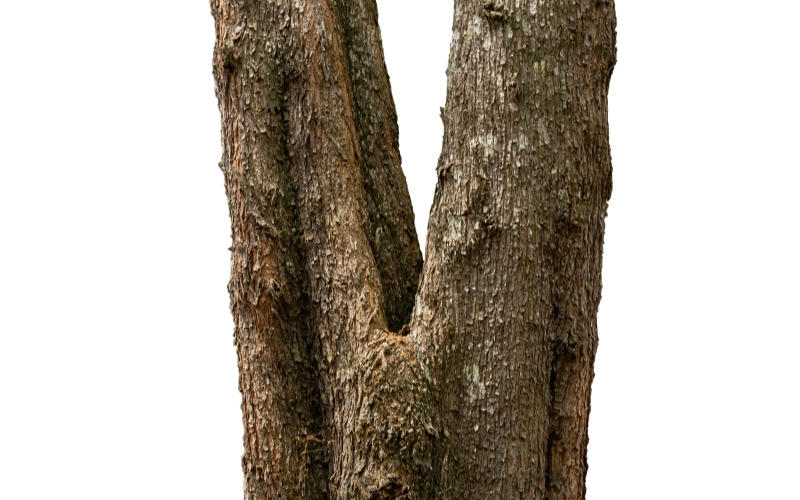
Codominant trunks like this often need cabling to prevent splitting – one of the most common structural issues we see in Winston-Salem trees.
Co-Dominant Stems
Co-dominant stems occur when two or more trunks grow from the same point on a tree, creating a V-shaped union. You’ve probably seen this countless times without realizing it was a potential problem. The issue lies in what arborists call “included bark” – the compressed bark trapped inside the junction where the two stems meet.
Unlike a normal branch attachment where wood fibers interlock to create strength, included bark creates a weak point with limited physical connection between the stems. As the tree grows larger and heavier, this weak attachment becomes increasingly stressed. Oaks and maples are especially prone to this structural defect, which is why it’s so common throughout Winston-Salem’s established neighborhoods where these species dominate the landscape.
Here’s some reassurance: most co-dominant stems don’t fail. However, the statistical risk is higher than with properly attached branches, and that risk increases as the tree matures and adds weight.
Structural Problems
Walk around your trees and look for these indicators that something may need attention:
- V-shaped union between main stems or large branches (especially if tight and narrow)
- Visible crack or seam running along the union area
- Signs of decay near branch attachments, such as soft wood, fungal growth, or carpenter ant activity
- Leaning that has changed or increased over time
- Branches that seem disproportionately long or heavy for their attachment point
- Bark that appears to be pushing outward at a branch junction
Some of these signs are more urgent than others. A visible crack in the union requires immediate professional assessment, while a V-shaped union without other symptoms may simply need monitoring. If you notice multiple warning signs on the same tree, or if you’re unsure what you’re seeing, it’s worth having an arborist take a look.
How Does Tree Cabling Save At-Risk Trees?
Tree cabling connects weak branches or stems to stronger ones, redistributing stress loads to prevent failure during storms. Modern systems, like Cobra, do this without damaging the tree.

A dynamic cabling system helps these codominant trunks move safely in the wind while preventing dangerous splits.
How Traditional Cabling Works
Cables are typically installed at approximately two-thirds of the tree’s height, where they can most effectively limit movement at the weak point below. Professional installation often combines cabling with reduction pruning to decrease weight on problematic limbs. This dual approach addresses both the structural weakness and the stress load on that weakness.
The Cobra Cabling System: Modern, Non-Invasive Tree Preservation
At Godspeed, we use the Cobra cabling system – a German-engineered system that represents the latest advancement in tree support technology. Unlike older steel cable systems that require drilling into the tree, Cobra is completely non-invasive and has proven very successful at preventing canopy breakage.
Here’s what makes Cobra different from traditional cabling methods:
- No Drilling Required: Preserves tree health completely
- UV-Protected Rope with Built-in Shock Absorbers: Cushions sudden loads during storms rather than creating rigid stress points
- Self-Adjusting Design: Expands as the tree grows, eliminating the risk of girdling (where hardware cuts into bark over time)
- Allows Natural Movement: The tree continues to sway naturally, which actually encourages stronger wood development
A properly installed Cobra system typically lasts 10-15 years and requires inspection every three years. For valuable mature trees with structural concerns, it’s an excellent preservation option that protects your tree without damaging it in the process.
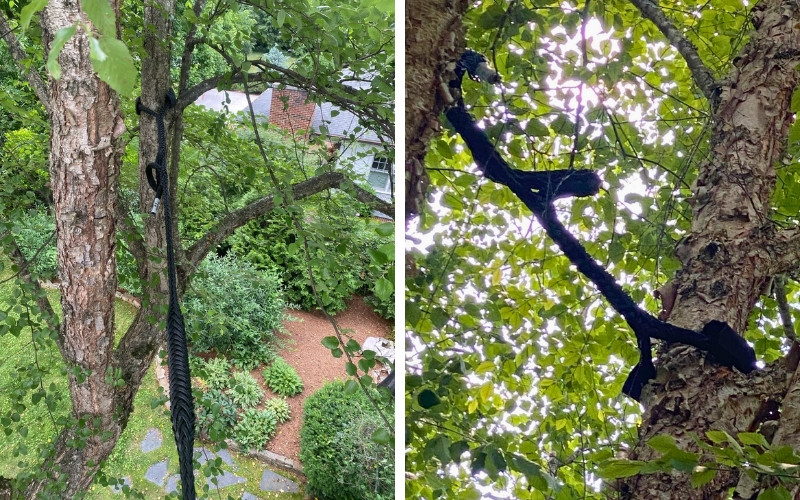
Cobra cables offer flexible, non-invasive support that strengthens vulnerable limbs without harming the tree.
Can Cabling Save Your Tree – Or Is Removal Better?
Whether cabling can save your tree depends on several factors, including the tree’s overall health, the type of structural defect, and what’s at risk if failure occurs. Here’s how to think through the decision.
Good Candidates for Tree Cabling
Cabling works best for trees that meet these criteria:
- Co-dominant stems that show no decay or visible cracks in the union
- Otherwise healthy trees with overextended branches that need additional support
- Valuable mature trees worth preserving – typically 50+ years old with significant canopy
- Trees that would be expensive to remove and replace
- Situations where the tree provides irreplaceable shade, screening, privacy, or aesthetic value
If your tree checks most of these boxes, cabling may be an excellent investment that extends the tree’s lifespan for another decade or more.
When Removal Is the Better Choice
Cabling has real limitations. For some trees, removal is the safer and smarter choice if you notice any of the following:
- Visible decay in the union area (soft wood, fungal conks, hollow sections)
- Existing cracks or splits at attachment points – these indicate the failure process has already begun
- Dead or dying trees – cabling cannot save a tree in health decline
- Trees with multiple structural issues that would require extensive cabling
- Significant lean that has progressed or worsened over time
- High-value targets directly below, such as your home, children’s play area, or vehicles
This last point deserves emphasis. When the consequence of failure is catastrophic, such as a tree falling on your house or family, even a small failure risk may be unacceptable. A Certified Arborist will tell you when the responsible choice is removal, even if cabling is technically possible.
Frequently Asked Questions About Tree Cabling
How long does tree cabling last?
Modern dynamic cabling systems, like Cobra, typically last 10-15 years. The cables should be inspected by a Certified Arborist every 3 years to ensure proper function.
Is tree cabling a guarantee against failure?
No, tree cabling isn’t a guarantee against failure. Cabling significantly reduces failure risk, but it isn’t a guarantee. Severe weather events, tree diseases, or hidden decay can still cause problems. Regular inspection helps identify issues early.
Can cabling save a dying tree?
No, cabling can’t save a dying tree. Cabling addresses structural weakness, not health issues. An arborist must assess whether the tree is healthy enough to benefit from support.
What are co-dominant stems and why are they a problem?
Co-dominant stems are two or more trunks growing from the same point, forming a V-shape. Compressed bark in the junction creates a weak attachment prone to failure.
Does cabling damage the tree?
The Cobra system we use requires no drilling and doesn’t damage the tree. It’s completely non-invasive, which is one of the key advantages over older steel cabling methods.
When is removal better than cabling?
Removal is better when there’s visible decay, existing cracks, the tree is dying, or failure risk over your home is too high to manage with support alone.
Find Out What Your Tree Really Needs with Godspeed
Structural problems in trees are common throughout Winston-Salem’s established neighborhoods, and they deserve to be taken seriously. But removal isn’t always the answer. Modern cabling technology can preserve valuable mature trees for another decade or more when the tree is a good candidate.
Godspeed’s Certified Arborists can assess your tree’s condition, explain what’s going on inside, and help you understand your safest and most cost-effective options.
Ready to find out if cabling can save your tree? Schedule a free tree assessment with Godspeed Tree Service. Call us at 336-448-4621 or request a quote online to get started.
Godspeed Tree Service
Owned and operated with high standards and consistent reliability by Bobby Gates, Godspeed Tree Service has earned the trust of the North Carolina Triad community over the course of more than 25 years in business. With a strong emphasis on safety, conscientious training, and accommodating the needs of each client, you can't go wrong by hiring Godspeed for any of your tree service needs!